We all have great talents to contribute to others.
I hope to do my part to help the world, and not just members of my human family
- every member of it. Once we realize this is important,
we will no longer need to worry about our future... everything is connected. -Sofia Penabaz
Words and things that inspire me...
The World
MORNING.
By Edward Rowland Sills
I ENTERED once, at break of day,
A chapel, lichen - stained and gray,
Where a congregation dozed and heard
An old monk read from a written Word.
No light through the window-panes could pass,
For shutters were closed on the rich stained-glass;
And in a gloom like the nether night
The monk read on by a taper's light.
Ghostly with shadows, that shrank and grew
As the dim light flared, were aisle and pew;
And the congregation that dozed around,
Listened without a stir or sound
Save one, who rose with wistful face,
And shifted a shutter from its place.
Then light flashed in like a flashing gem
For dawn had come unknown to them
And a slender beam, like a lance of gold,
Shot to the crimson curtain-fold,
Over the bended head of him
Who pored and pored by the taper dim;
And it kindled over his wrinkled brow
Such words- "The law which was till now;
And I wondered that, under that morning ray,
When night and shadow were scattered away,
The monk should bow his locks of white
By a taper's feebly flickering light
Should pore, and pore, and never seem
To notice the golden morning-beam.
Anime
One of the cultural aspects of Japan that I have always appreciated, is the beautiful art.
A modern form of Japanese Art is Anime. Different from Ukio-e or Sumi-E
(which I studied for three years during my life there) it still
exhibits Japanese wabi-sabi qualities of simplicity and precision.
UTENA
These are selected pictures (jpegs) from my favorite anime/manga series.

This picture of "Anthy, the Rose Bride" from the "Revolutionary Girl Utena"
will lead you to an encompassing Utena Page.
CHOBITS
The next pic is from a darling manga/anime called Chobits,
and illustrated is the lead character, a super computer named Chii.
It is the love story of a man and his machine.
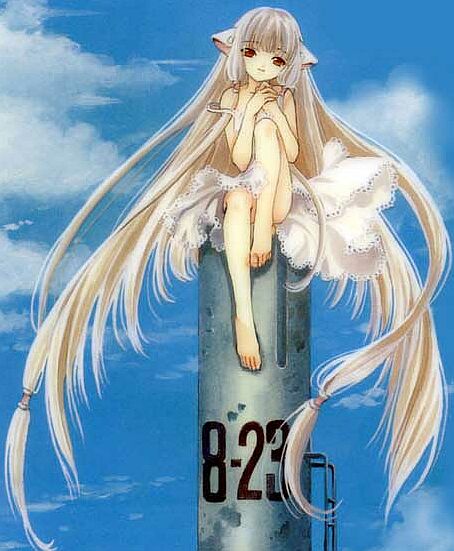
We all have great talents to contribute to others. I hope to do my part to help the world and all of its inhabitants!
Desiderata
DESIDERATA
* Go placidly amid the noise and haste, and remember what peace there may be in silence. * As far as possible, without surrender, be on good terms with all persons. Speak your truth quietly and clearly; and listen to others, even to the dull and ignorant; they too have their story. * Avoid loud and aggressive persons; they are vexations to the spirit. * If you compare yourself with others, you may become vain or bitter, for always there will be greater and lesser persons than yourself. * Enjoy your achievements as well as your plans. Keep interested in your own career, however humble, it's a real possession in the changing fortunes of time. * Exercise caution in your business affairs, for the world is full of trickery. But let this not blind you to what virtue there is; many persons strive for high ideals, and everywhere life is full of heroism. * Be yourself. Especially do not feign affection. Neither be cynical about love; for in the face of all aridity and disenchantment, it is as perennial as the grass. * Take kindly the counsel of the years, gracefully surrendering the things of youth. * Nurture strength of spirit to shield you in sudden misfortune. But do not distress yourself with dark imaginings. Many fears are born of fatigue and loneliness. * Beyond a wholesome discipline, be gentle with yourself. * You are a child of the universe no less than the trees and the stars; you have a right to be here. And whether or not it is clear to you, no doubt the universe is unfolding as it should. * Therefore be at peace with God, whatever you conceive him to be. And whatever your labors and aspirations, in the noisy confusion of life, keep peace in your soul. * With all its sham, drudgery and broken dreams, it is still a beautiful world. Be cheerful. Strive to be happy.
From the Alt.Usage.English FAQ: "Desiderata" was written in 1927 by Max Ehrmann (1872-1945). In 1956, the rector of St. Paul's Church in Baltimore, Maryland, used the poem in a collection of mimeographed inspirational material for his congregation. Someone who subsequently printed it asserted that it was found in Old St. Paul's Church, dated 1692. The year 1692 was the founding date of the church and has nothing to do with the poem. See Fred D. Cavinder, "Desiderata", TWA Ambassador, Aug. 1973.